
Players and makers
Toque Play is for practicing those toques on a real berimbau. Mestre Bimba appears here because his Curso de Capoeira Regional sits beside the other early discs. Mestre Pastinha, the patron of Capoeira Angola, is a different kind of figure and is not profiled on this page.
Mestre Paraná
Oswaldo Lisboa dos Santos (25 September 1922, Salvador – 7 March 1972, Rio de Janeiro), known as Mestre Paraná, was a capoeira mestre and musician. CapoeiraWiki describes him as one of the most accomplished berimbau players of his generation. He learned capoeira in Salvador’s Alto das Pombas from Mestre Antônio Corró, moved to Rio de Janeiro in the 1940s among the first Bahians of his generation to settle there, and founded the Conjunto Folclórico de Capoeira São Bento Pequeno. A carpenter, he built his own berimbaus, with covered strings and varnished wood.
In 1963 CBS released Capoeira – Mestre Paraná, one of the earliest commercial capoeira records. Three tracks are instrumental toques named São Bento Grande, São Bento Pequeno, and Angola; the fourth is the corrido “Avise a meu Mano.” CapoeiraWiki notes that he was the only capoeira mestre with a card from the Ordem dos Músicos do Brasil as a berimbau player, and traces a later Rio line from his student Mestre Mintirinha to Mestre Paulão of Grupo Muzenza.
Mestre Waldemar
Waldemar Rodrigues da Paixão (22 February 1916 – 1990), known as Mestre Waldemar or Waldemar da Liberdade, held an open Sunday roda in a shed in Corta-Braço, later the Liberdade neighborhood of Salvador. CapoeiraWiki calls that roda one of the most important meeting points for Bahian capoeiristas, open to players of different styles. In an interview cited there, he said he introduced painting the berimbau. Making and selling instruments became part of his income.
Ethnographers recorded the berimbaus at his roda: Anthony Leeds in 1951–52 and Simone Dreyfus in 1955. He is one of the berimbau players in the 1954 film Vadiação. Cais da Bahia names him, with Mestre Pastinha and Mestre Bimba, among the people who practiced the capoeira later called Capoeira Angola. In the mid-1980s he recorded with Mestre Canjiquinha. The picture is the public statue at Arena da Capoeira in Salvador, not a photograph from his lifetime.
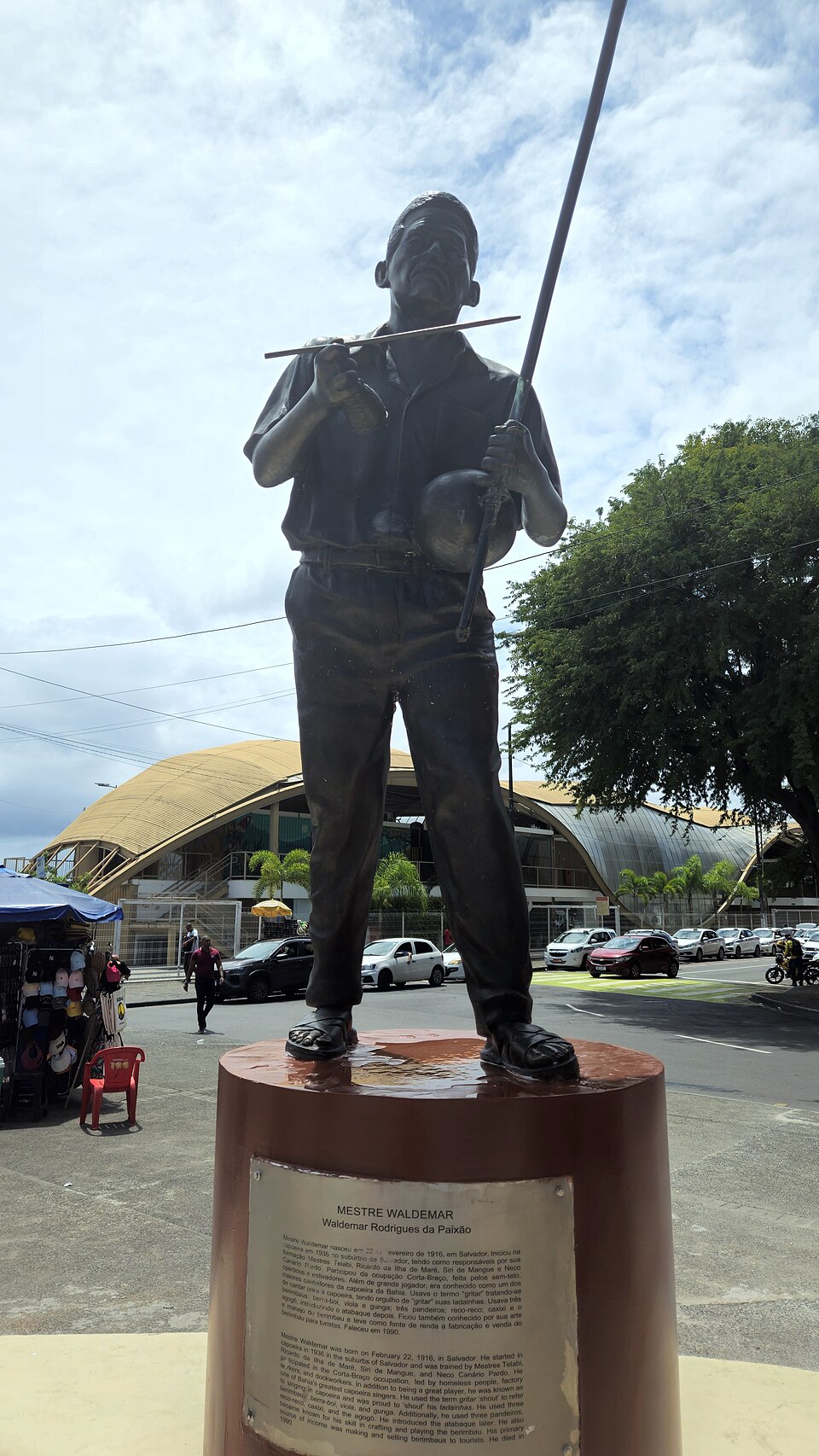
Statue of Mestre Waldemar at Arena da Capoeira, Salvador, with a berimbau.
Mestre Canjiquinha
Washington Bruno da Silva (1925–1994), known as Mestre Canjiquinha, played the berimbau in his own way: held in the right hand at chest height, the stick in the left. CapoeiraWiki notes that he was contra-mestre in Mestre Pastinha’s academy without having been Pastinha’s student, then opened his own. He treated Angola and Regional as different rhythms rather than rival creeds. Cais da Bahia quotes him to the effect that he was a capoeirista, and that the game follows the toque: a slower toque, a slower game; a faster toque, a faster one. That page says some researchers credit him with the toque Samango. He recorded with Mestre Waldemar in the mid-1980s.
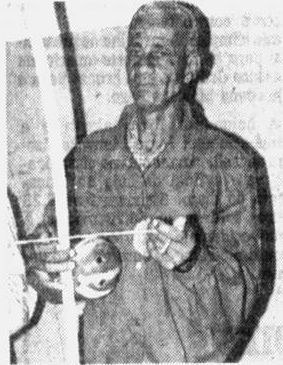
Mestre Canjiquinha with a berimbau. Photograph in the newspaper A Tribuna, 11 August 1984.
Mestre Traíra
João Ramos do Nascimento, known as Mestre Traíra, trained with Mestre Waldemar and kept a roda in Liberdade. CapoeiraWiki remembers his musical skill and a hard game. In Vadiação (1954) he is listed on pandeiro, while Waldemar is among the berimbau players. In 1962 he took part in the LP Capoeira da Bahia on the Xauã label, with Mestres Cobrinha Verde and Gato Preto — one of the earliest musical documents of capoeira in Bahia.
Three early records, and Bimba’s Regional LP
CapoeiraWiki places three early commercial discs side by side: Mestre Bimba’s Curso de Capoeira Regional (1962), Mestre Paraná’s CBS compact (1963), and Mestre Traíra’s Capoeira da Bahia. The same encyclopedia calls Bimba an excellent singer and berimbau player. Capoeira Shop says the Regional LP, issued with a booklet in the early 1960s, names seven toques on the cover, including São Bento Grande, Cavalaria, Banguela, Santa Maria, Idalina, and Amazonas. Schools do not share one pattern under every name.
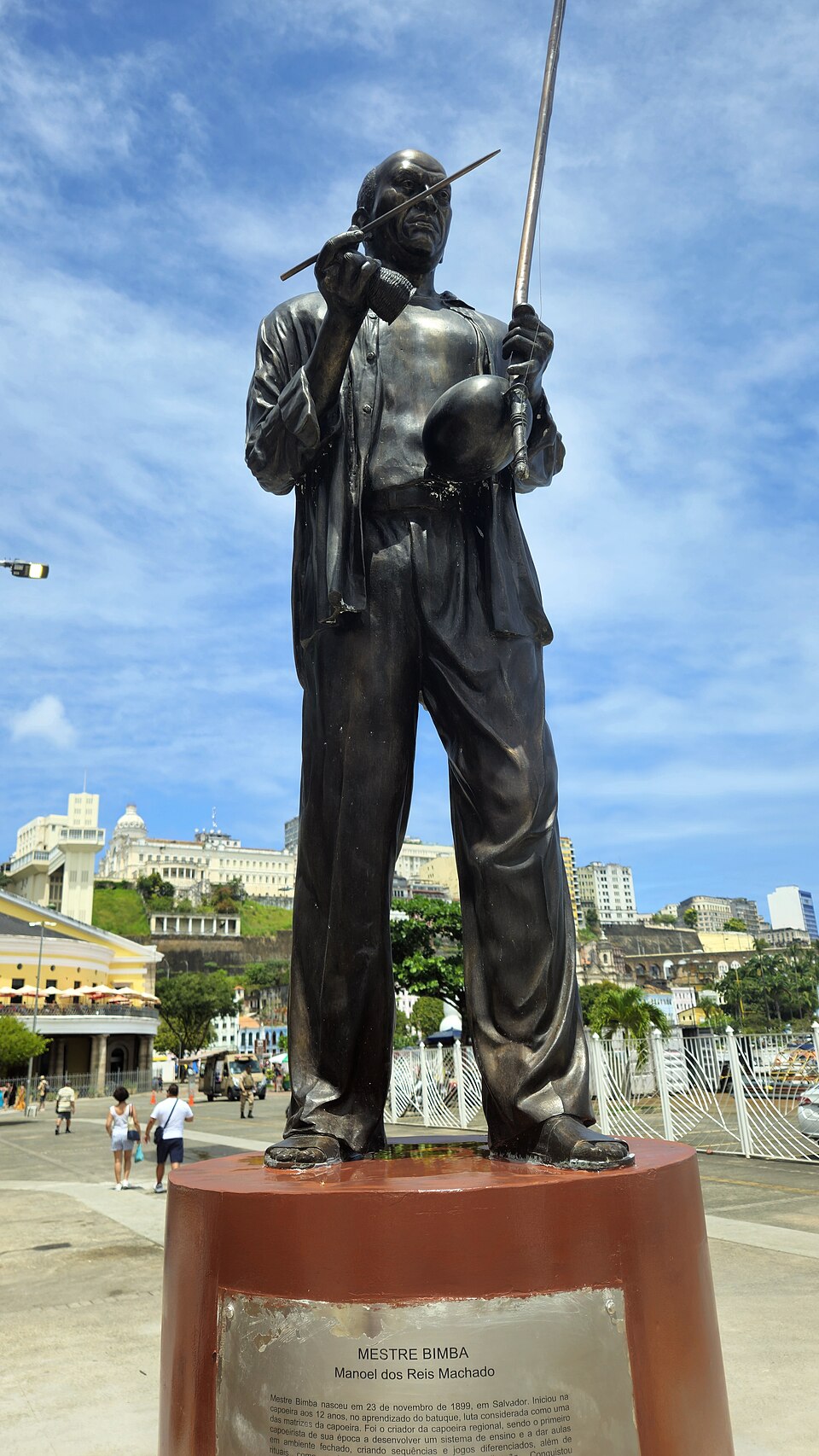
Statue of Mestre Bimba at Arena da Capoeira, Salvador, with a berimbau.
Photo: Malikss19, 14 September 2024. CC BY-SA 4.0. Wikimedia Commons.
The workshop after Waldemar
Building berimbaus continued after that generation. CapoeiraWiki describes Mestre Olavo (Olavo Paixão dos Santos, born 1942) as a player and maker who started in 1958 and learned construction from Mestre Waldemar, including steel wire and painted gourds. In May 2021 the state of Bahia gave him the title Mestre Artesão together with Mestre Lua Rasta.
Practice the toques
The early discs use these names. In Toque Play you practice them on a real berimbau: the browser scores pitch and timing, and the audio stays on your device.
Sources
The text paraphrases these pages:
- CapoeiraWiki — Mestre Paraná
- CapoeiraWiki — Mestre Waldemar
- CapoeiraWiki — Mestre Canjiquinha
- CapoeiraWiki — Mestre Traíra
- CapoeiraWiki — Mestre Bimba
- CapoeiraWiki — Mestre Olavo
- Capoeira Shop — berimbau toques in Capoeira Regional
- Cais da Bahia — Capoeira Angola
- Wikimedia Commons — photograph of Mestre Canjiquinha
- A Tribuna, 11 August 1984 — Hemeroteca Digital Brasileira
- Wikimedia Commons — statue of Mestre Waldemar
- Wikimedia Commons — statue of Mestre Bimba